
The rise of IoT (Internet of Things) devices has occurred concurrently with a similar shift in the eCommerce industry. Technological developments are reorganizing the customer lifestyle, making it more adaptive. Customer behaviours and purchasing power are forming under the influence of IoT development solutions such as headless eCommerce, predictive maintenance and remote monitoring.
In turn, companies are revolutionizing the way they do business, adjusting to the IoT. The innovation pipeline has brought massive transformation to the execution of eCommerce transactions. Companies operating in the online space have to make shopping unforgettable by providing state-of-the-art products and services.
In 2023, we expect IoT spending to reach roughly $1.1 trillion worldwide. This article will focus on five significant modifications that IoT technology brings to the eCommerce industry.
How Do IoT Solutions Enhance eCommerce?
1. Exploring New Shopping Platforms
Today’s sellers offer customers a new experience and accessibility to online shopping beyond their phones and computers. Now customers can push a button and get what they want on the go as quickly as possible with the help of IoT. The Internet of Things is becoming an intermediary between web developers and retailers, providing an unprecedented customer experience.
To prove my point, IoT can become not only a tool to find products but also the media to buy products. We see this in various marketplaces including smart fridges, TVs, voice assistants such as Alexa, etc. Standard monolithic eCommerce websites have the back-end and front-end tied closely together. However, traditional shopping gives way to alternative solutions, transferring retail to a headless commerce architecture.
In this case, the developers decouple the front-end from the back-end and create connections using API. Thanks to this omnichannel solution, the eCommerce industry can leverage IoT devices and different sales channels.
2. Better Relationships Lead to More eCommerce Sales
IoT aids in building a relationship with a client and re-engages them to buy more products from the company. For example, let’s say you sold a printer with monitoring and performance analytics features. Built-in intelligent sensors help identify service needs and send information about how often and how long the client uses the printer. When a cartridge runs out and needs replacing, the printer can signal the user about it.
In addition, modern printers can automatically send the order to the point of sale themselves, which requires minimal human intervention. Moreover, the printer can send a report to the seller to solve specific problems and provide the customer with personalized brand suggestions.
3. Logistic Benefits of IoT and AI
Online store owners also need to think about improving logistics and avoiding unnecessary costs. IoT assists in this area as well, leaving its mark on applications for intelligent transportation. The main advantage of IoT is remote monitoring.
IoT helps track how properly transportation conditions are observed and how the quality of goods in containers changes. This phenomenon is possible due to sensors that scan data about the conditions inside the container.
Also, many retailers use GPS systems to optimize routes and determine the course of vehicles. Depending on the weather, the Internet of Things and AI can automatically correct routes, ensure reasonable fuel consumption, and prevent other possible disruptions.
4. New Era of Retail Outlets
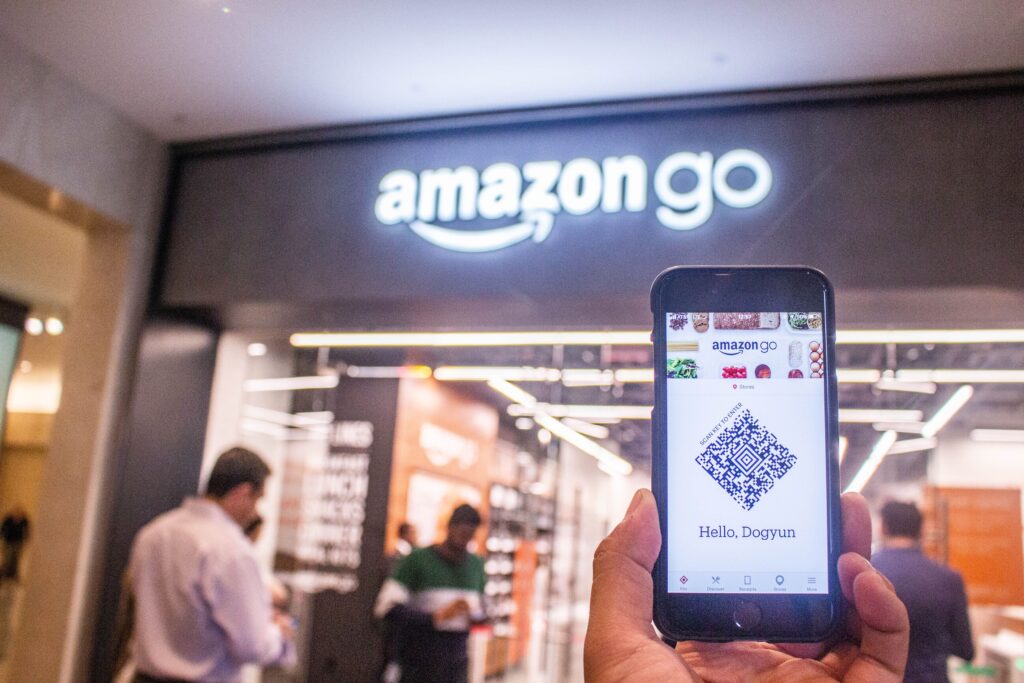
Online sellers are entering the arena of brick-and-mortar shops and opening up innovative retail locations. One example is the eCommerce giant Amazon, which launched three Amazon Go outlets in Seattle and one in Chicago in 2019. The essence of such a store is that all purchases are made through a mobile application.
The company ultimately got rid of checkouts and queues, offering a unique experience to its customers. Sensors and cameras, which are attached to the shelves in the supermarket, analyze how many items are left. When a customer picks up something from the shelf, the item is displayed in their in-app virtual shopping cart.
If a customer returns an item, it also disappears from their cart. Customers’ purchases are automatically debited from their accounts as soon as buyers leave the retail center. All smart shops are expected to follow this path soon and save on the number of staff required to serve at the point of sale.
5. Inventory Management Reducing Costs
IoT sensors as well as RFID, also known as Radio Frequency Identification tags, streamline the inventory process. Sensors display all vital information about an item, such as the product expiration date, availability, and type, without the need for any human intervention.
Thanks to them, business owners can control the temperature in the warehouse for perishable goods and whether there is a need to replenish stocks. And customers can check product availability.
For instance, sensors built into smart refrigerators show the temperature on the shelves and in the compartments and alert the system if the temperature doesn’t correspond to the norm. These technologies minimize the risk of human error and also reduce the required number of working hours.
To Sum Up
Store success in the 21st century is highly dependent on technology. As the number of online purchases grows every day, retailers are introducing innovative solutions. Leveraging the Internet of Things in eCommerce is one of the most exciting approaches to competitiveness.
The prospects for getting the most out of the market using the IoT are countless. With more sensors, microchips, and actuators in place, the IoT has already reformed the eCommerce industry.
About the Writer: Alex Husar, Chief Technology Officer at Onilab with almost a decade of successful Magento migration and PWA development projects for eCommerce companies around the globe. Being a Computer Software Engineering specialist, Alex is equally competent both in terms of full-stack dev skills and the capability to provide project-critical guidance to the team.
