
The impact of computer vision on healthcare
Technology is driving huge disruption and innovation within healthcare. Big data, machine learning, and artificial intelligence-led applications are benefiting the ways in which medical professionals diagnose and treat patients.
Google Brain has recently made a significant breakthrough in computer vision. In 2011, the error rate was 26% for computers analyzing images. Today, computers are able to recognise and analyse images better than humans. We’re talking about an error rate of only 3% compared to a 5% error rate of humans! This opens up huge opportunities for this technology in an array of sectors including healthcare. Medical imaging accounts for a huge part of medicine, from image registration and annotation, image-guided therapy through to computer diagnostics.
Unfortunately, human error is no stranger to the healthcare sector and can put lives at risk. Whilst medical professionals strive to deliver the best care they can, is the time for AI-led healthcare here? And is computer vision really capable of providing more thorough results than doctors?
The AI healthcare market
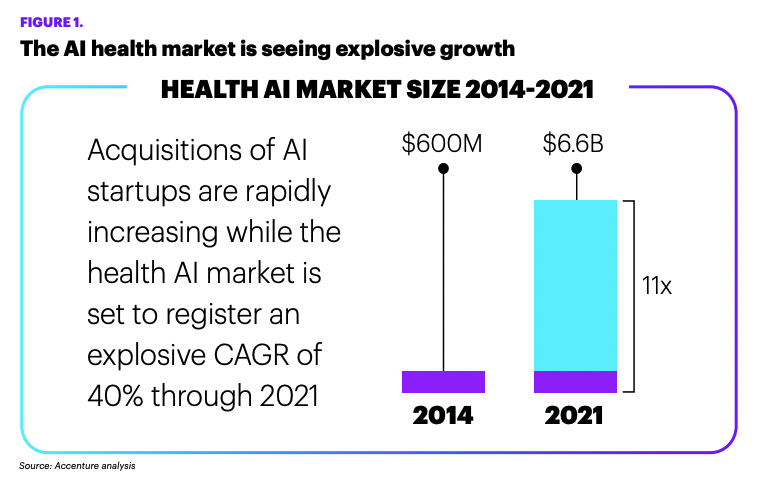
Accenture’s recent report (snippet above) suggests that the AI health market size is set to grow to a huge $6.6billion by 2021, at an annual rate of 40%. This growth is enormous and signals a radical change in healthcare that will ultimately benefit the lives of millions.
Computer vision in healthcare is playing a vital role in medical image analysis, allowing for noninvasive diagnosis of many conditions and diseases and other areas such as image-guided radiotherapy and even medication adherence using facial recognition.
We’re seeing massive leaps in diagnosis through computer vision. Pathologists diagnose cancers by using slides and tests to detect the presence of cancerous tumours, however, research has shown that the error rates for oncology are between 1 – 5%. As reported in Silicon Angle, pathologists only agree on some cancer diagnoses 42% of the time. It’s proven that computer vision and deep learning technologies with successful diagnoses have higher accuracy than humans. Google Brain reached an almost 90% success rate in diagnosing cancer. It is also evident in skin cancer detection with IBM’s Watson, which achieved a success rate of 91% earlier this year.
Nvidia has also had success in deep learning assisted pathology in the past too. Their team managed to identify cancer 92% of the time, almost levelling the human pathologists at 96% success rate in the project. When used together, both human and deep learning, they achieved a 99.5% success rate. This clearly cements the much-needed presence of AI in diagnostics.
What the future holds
When applied to real-world medical treatment, the application of this technology will undoubtedly aid in faster diagnoses and more effective treatments for patients. Right now, especially in the UK, we’re seeing immense pressure put on our health services. Long waiting times for appointments and for the following results are unfortunately a norm for many. AI-led technology should eliminate these often fatal waits. We can expect to see diagnoses for diseases such as cancer taking place in a matter of minutes. This is all with the help of computer vision and 3D imaging.
AI-led diagnoses will constantly be improving, and machine learning and pattern recognition systems will get more powerful and faster at processing images. Paired with a medical practitioner’s input, this will have a significant impact on global healthcare systems.
