
The impacts of crises are never gender neutral, and COVID-19 is no exception. While men reportedly have a higher fatality rate, women and girls are especially hurt by the resulting economic and social fallout.
UN WOMEN From Insight to Action: Gender Equality in the Wake of COVID-19.
COVID-19 has continued to exacerbate ongoing issues surrounding global gender parity. Whilst men were disproportionately affected by the 2008 recession in employment, it seems that COVID-19 has had similar effects for women. The World Economic Forum’s Global Gender Gap Report 2020 notes that of the 153 countries they analysed, 72 of them do not permit women of certain social groups to obtain credit or open a bank account. Financial restrictions like these leave women disadvantaged in crises. This occurs particularly in the Middle East and North Africa region. Here they are less likely to have the rights to access land, capital and other assets.
Not only are women financially restricted in crises, but their health and wellbeing is also at risk. The move to working from home has put men and women at increased exposure to intimate partner violence (IPV). The stress and anxiety of the pandemic have resulted in an estimated global rise of 243 million women and girls aged between 15 and 49 experiencing IPV in the past year.
Youth disproportionately affected
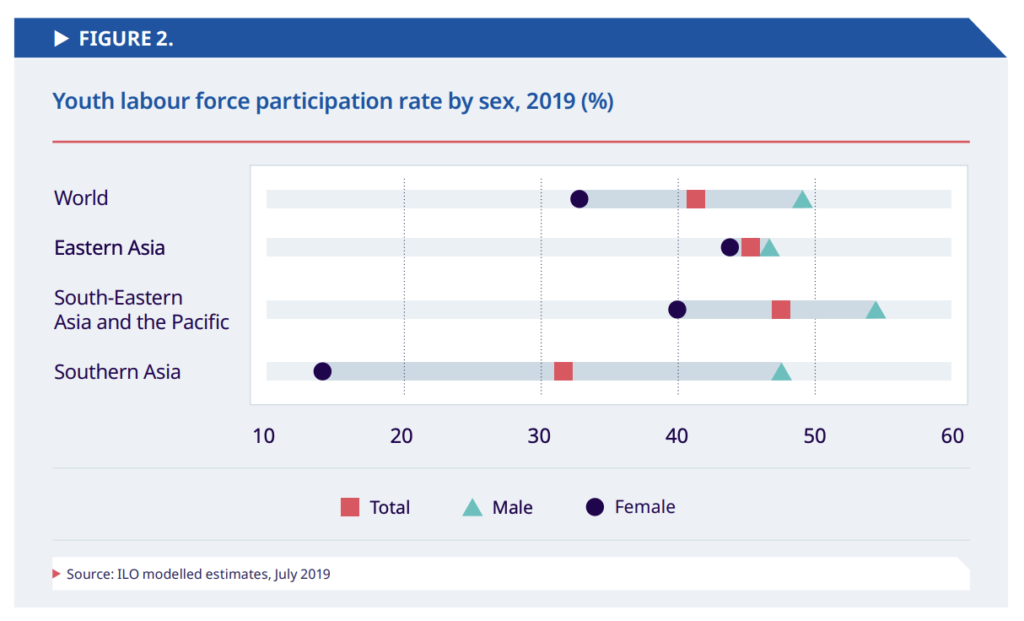
The younger generation has also faced significant hardships throughout the pandemic. COVID-19 has displayed that businesses are much less inclined to financially support youths with low job tenure. Instead, they face total job loss. This is particularly apparent in the Asia Pacific, where 55% of the worlds young people reside. Prior to the crisis, youths were already vulnerable in employment. As seen below, in 2019 the unemployment rate of women not in education or training (NEET), supersedes that of men. It is most notable in South Asia, where up to 49% of women were NEET.

32% of youths in South Asia made up the labour force participation rates for 2019, which was lower than the global average. At this time, young women only made up 14% of this workforce.
Once the pandemic began, young people aged 15-24 suffered an employment loss 3-18 times greater than their share in total employment. In Japan, 1 in 3 (34.6%) job losses were held by young people. Their youth share in total employment is fewer than 1 in 10 (8.9%) in this country. In Taiwan, the employment of adults actually increased by 6,000, whilst 22,000 youths were unable to attain jobs.
Domestic workload unmanageable
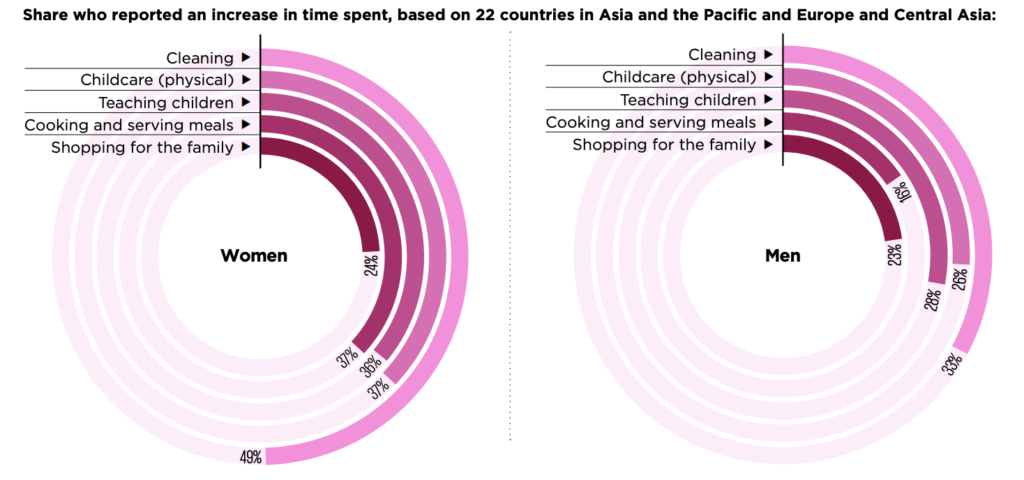
Before the pandemic, globally young women spent almost triple the amount of time on unpaid care and domestic work than young men. Since then, working from home has intensified unpaid care and domestic workloads. Both men and women are sharing this burden, but women are still doing the lions share. They spend nearly the equivalent of a full-time job doing unpaid childcare – A full working day a week longer than the average man. With children now at home during the working week, balancing priorities just became that much harder. In fact, 43% of new mothers in STEM will switch fields, downgrade to part-time work, or leave the workforce entirely to focus on family.
Jobs lost in overrepresented sectors
The sectors women work in are often overrepresented, and they are 1.8 times more likely than men to experience job vulnerability as a result of COVID-19. Women only make up 39% of global employment, but they have also accounted for 54% of total job losses. Globally, women make up 70% of the health and social care workforce. They represent the majority of front-line health workers and are 3x more likely to be infected with COVID-19 in this sector.
Social distancing and other legal enforcements resulted in female-majority sectors such as hospitality, retail and entertainment being hit especially hard by the pandemic. It is in these sectors where informal working environments can run rife. Informal work is established by low pay, poor working conditions and a lack of basic workers protection. This can include no access to sick pay, maternity leave or a pension. Informal workers are at higher risk of job loss, where consequently 740 million women earn their living.
One study found that women may be submitting fewer papers as a result of the pandemic. Looking at preprint servers arXiv and bioRxiv, this study compared the number of papers posted by women and men between 15 March and 15 April in 2019 and 2020. Between these dates, the number of papers on arXiv authored by women grew by 2.7%, compared to 6.4% for men. There was a 2% difference in the number of papers on bioRxiv.
We will carry the pandemic through history, so let it remind you of one thing. This crisis has worsened pre-existing social issues and inequality, that globally we were already struggling to tackle. Minority groups are already disadvantaged enough, without the onslaught of a pandemic.
